

1950
Roger Perrinjaquet invents the bamix®
On 6 March 1950 the Swiss inventor files the patent for a “portable kitchen appliance” – the world’s first hand blender. Its name comes from the French “battre et mixer”.
It started with a Swiss patent for a “portable kitchen appliance” – and became the hand blender that kitchens around the world have trusted for more than 70 years. This is the bamix® story.
Explore the timeline ↓On 6 March 1950, Roger Perrinjaquet from Lausanne filed a patent for an “appareil ménager portatif” – a portable kitchen appliance. The patent specification describes the world’s first hand blender: a motor in an insulating housing that drives a tool at the end of a protective tube, used directly in the container.
The name says what it does: battre et mixer – to beat and to mix.
On 6 March 1950 the Swiss inventor files the patent for a “portable kitchen appliance” – the world’s first hand blender. Its name comes from the French “battre et mixer”.

The patent is registered on 31 January 1953. Werner Spingler and Josef Gschwend found ESGE – named after their initials “S” and “G”. With seven employees they initially produce bicycle stands, saws and small electric motors.
From the beginning, bamix® is presented live – at fairs, events and demonstrations, where the new appliance wins over its audience in seconds.
In November 1960 the production company ESGE AG, Elektrogerätefabrik, is founded. A former textile factory from 1906 in Mettlen is acquired – in 1961 daily production of 250 appliances begins.
Motors are wound, tested and assembled by hand in the bright production hall in Mettlen – the beginning of more than six decades of Swiss manufacturing.

The housing of the bamix® M60 is redesigned by Acton Bjørn from Denmark and Count Sigvard Bernadotte from Sweden. The result, the M100, puts ergonomics first – and remains recognisable decades later. England becomes the most important sales country.
The founders sell their company to General Electric. Of the production sites, only Mettlen in Switzerland and Neuffen in Germany are retained.

At the first trade fair outside Europe, in Melbourne, almost 1,000 bamix® are sold – more appliances have to be flown in during the fair. bamix® Australia Ltd. is founded soon after.
The site in Mettlen with its production hall – home of bamix® production to this day.

The Processor attachment arrives – it chops and grinds dry and moist food very finely.

Professional chefs ask for a bamix® that is “just 5 centimetres longer”. After trials in hotel kitchens, the bamix® Gastro is launched – the start of today’s PRO line.
After three years of development, the SliceSy® closes the last gap: grating, slicing and shredding – small, handy and easy to clean, just like the bamix®.

bamix® partners with Gordon Ramsay on a special edition hand blender that combines the passion of a culinary icon with Swiss precision.

A new building for administration and logistics of the Swiss sales company is completed – together with the bamix® shop.

In cooperation with Jamie Oliver, an exclusive set with his recipes is launched, accompanied by videos on social media.

After years of development, the bamix® cordless is launched in three versions – BASIC, PLUS and PRO for professional kitchens.

bamix® celebrates its 70th anniversary with two exclusive anniversary colours – 70 years of innovation and Swiss craftsmanship.
From Casablanca to Stockholm, London and Santiago de Chile: bamix® was always shown live – at trade fairs, on stands and in front of an audience.
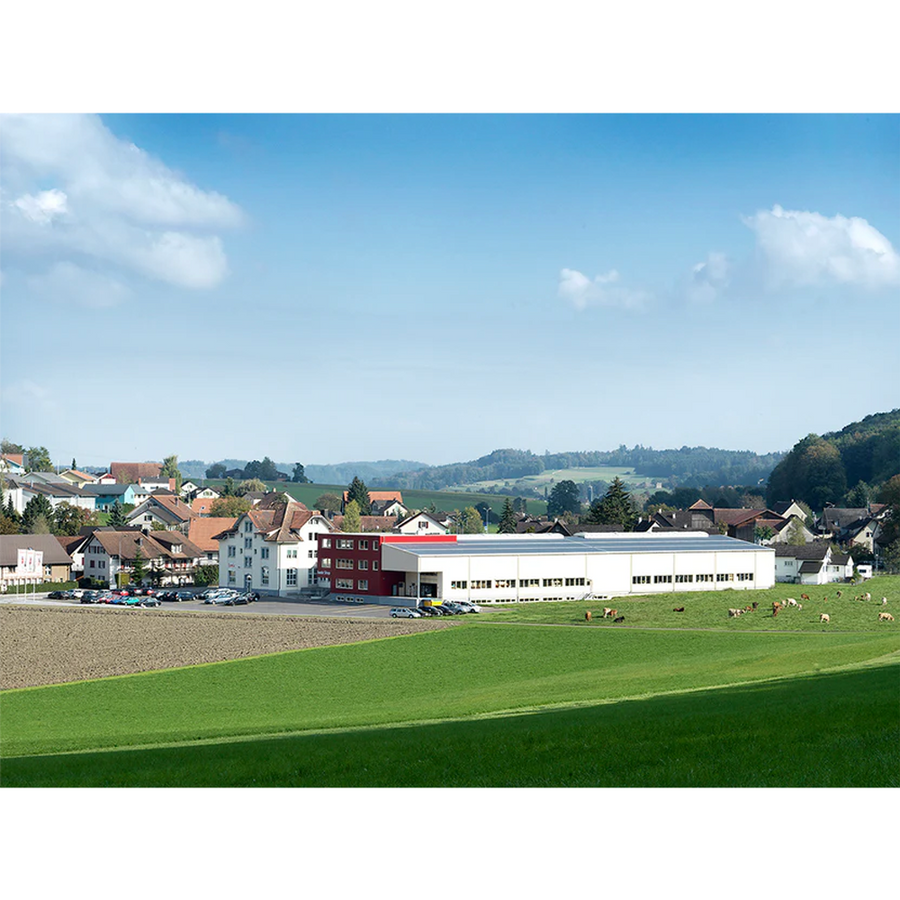
Since 1961, every bamix® has been built in Mettlen, Switzerland. Development, motor production, assembly and testing still happen at one site – and every device is switched on before it is packed.
That is why corded bamix® appliances carry a lifetime warranty on the motor.
Mettlen, today
Fabrication suisse
bamix® de Suisse est fière de sa manufacture artisanale, qui fabrique à la main chaque mixeur plongeant en Suisse pour garantir une qualité exceptionnelle. Forte d'un savoir-faire traditionnel, bamix® de Suisse assure des produits durables et performants, reflets d'un riche héritage et d'une précision suisse méticuleuse.